TLDR
A slate roof that leaks is rarely a dead roof. The National Park Service's repair guidance says the usual culprits are rusted nails, worn flashings, clogged gutters and valleys, not the slate itself, and that if fewer than about 20% of the slates are broken, missing or sliding, the roof should be evaluated for repair, not replacement. Don't let anyone seal cracks with roofing cement, don't walk the roof, and hire someone who has actually laid slate. In a Montclair historic district, changing the roofing material is the kind of visible exterior change the Historic Preservation Commission reviews, so check before swapping slate for something else.
Slate Roof Repair in Montclair, NJ: When to Repair, When to Replace, and Who Should Touch It
Slate was the premium roof of the late nineteenth and early twentieth centuries, and Montclair has plenty of houses from that era. If yours still wears its original roof, it has probably outlasted two or three generations of asphalt shingles on the house next door. It is also now old enough that things start to go wrong: a slate slides out of place after a storm, a stain shows up on a bedroom ceiling, a roofer on the phone says the whole thing has to come off. This guide is for sorting out what is actually wrong before anyone spends five figures on a decision.
How Long Slate Really Lasts
The best single reference for owners of old slate roofs is the National Park Service's Preservation Brief 29, “The Repair, Replacement, and Maintenance of Historic Slate Roofs” by Jeffrey S. Levine. It says properly installed slate needs relatively little maintenance and lasts 60 to 125 years or longer, depending on the type of slate, the roof's configuration and where the building is. Some slates have lasted over 200 years.
Where your slate came from matters. The brief reports that Vermont and New York slates will last about 125 years, Buckingham Virginia slates 175 years or more, and Pennsylvania soft-vein slates in excess of 60 years. It also notes that so-called ribbon slate, which shows bands on the cleavage face and was common in Pennsylvania quarries, weathers faster than clear slate and is no longer made for roofing. Many older Northeastern houses carry one of these types, and a slater can usually identify it by color, thickness and the way it weathers.
Here is the practical takeaway for a Montclair homeowner. A slate roof installed around the turn of the twentieth century is now at or past the low end of those ranges, which is why the question comes up. But age alone does not mean the roof is finished. In most cases, the part that wears out first is not the stone.
What Actually Fails: Nails, Flashings and Gutters
The Park Service brief is blunt about this, and it is the most useful thing to understand before talking to any contractor.
Nails
Slates hang on nails. The brief says plain steel and galvanized nails will usually rust out long before the slate itself starts to deteriorate, and that the rusting of nineteenth-century cut nails is a common cause of slate loss on historic roofs. When slates start sliding out of position across a roof, the brief's guideline suggests the cause may be corroded ferrous fasteners while the slates themselves are still in good condition. In that case the slates can be salvaged and re-laid with new fasteners. Modern repair uses non-ferrous slater's nails, such as solid copper or stainless steel.
Flashings
The brief calls flashings the weakest point in any roof, and says that because slate is so durable, metal flashings often wear out before the slate does. Even a pinhole in a valley or at a chimney can let a lot of water in. On older Montclair houses with multiple gables, dormers and chimneys, there are many places for this to happen. The Park Service recommends copper for flashings, with 16-ounce copper as the minimum weight and heavier 20- or 24-ounce copper for gutters, valleys and hard-to-reach spots, and it recommends using one metal throughout the roof, flashings, gutters and downspouts to avoid galvanic corrosion between dissimilar metals. If your leak is at a chimney, our chimney repair guide covers the masonry side of the same junction.
Gutters, valleys and ice dams
Built-in gutters, valleys and chimney crickets collect water and debris, and the brief lists ice dams in gutters and valleys as one cause of individual slate damage. It recommends cleaning gutters at least twice in the fall and once in early spring. Our gutter guide and ice dam guide explain those two problems for Montclair houses.
Installation errors and false leaks
Two more causes are worth knowing. Slate nailed too tightly cracks, and slates laid with too little overlap let water pass through joints and nail holes. And some “leaks” aren't leaks at all: the brief says moisture condensing in an attic with poor ventilation can mimic a roof leak. A contractor who blames the slate before looking at the flashings, the gutters and the attic is guessing.
Repair or Replace: The 20% Guideline
The Park Service includes a repair-or-replace guideline that is worth printing out and bringing to every estimate. Its central test: count the damaged and missing slates. If fewer than about 20 percent are broken, cracked, missing or sliding, and the roof is generally in good condition, it should be evaluated for repair. If 20 percent or more of the slates on a roof or a roof slope are in that condition, the brief says it is usually less expensive to replace the roof than to do individual repairs, particularly for roofs nearing the end of their life, because even an experienced slater will damage additional slates while working.
The same guideline lists other things to weigh before deciding:
- Age against expected life for the type of slate on the roof.
- Where the leaks actually are. Check gutters, valleys and flashings before blaming the slates.
- The sheathing and rafters. Look for moisture stains in the attic and probe the wood with an awl to test for rot. Very old, delaminating slates hold moisture and can rot adjacent wood even when nothing is visibly leaking.
- Whether the deterioration is uniform. Often it isn't. One slope, usually the one with the most sun and weather, may need replacing while the others only need repair, which lets an owner spread the cost over years.
- Slate condition by touch and sound. Sound slates are unaffected when pressed hard by hand; deteriorated slates feel brittle and crack. Tapped slates that have a full, deep sound are in good condition, and a dull thud suggests a slate in poor condition.
- Availability of matching slate. Even if replacement is the answer, the existing roof may need temporary repair while matching slate is located and ordered.
If your estimate says “the roof is done” without a count of damaged slates, a look at flashings and an attic inspection behind it, ask for those three things in writing. It is a fair question, and a contractor who knows slate will have the answers.
Get Slate Roof Repair Quotes in Montclair
Tell us what you can see (missing slates, a ceiling stain, a flashing problem) and we'll pass your request to local roofing contractors.
Inspecting a Slate Roof Without Damaging It
The fastest way to damage a slate roof is to walk on it. The Park Service brief says slate roofs should not be walked on if at all possible. For safety and for the roof's sake, it recommends that owners carry out roof surveys from the ground with binoculars, or from a lift. A few practical points for homeowners:
- Inspect annually and after severe storms. Look for cracked, broken, misaligned and missing slates, signs of flaking (delamination), failed flashings, and broken or clogged downspouts. Take photographs and sketch a rough roof plan so you can point to problem areas when talking to contractors.
- Check the attic. Water stains and rot show up first near the roof plate and where roof planes meet, such as valleys and hips.
- If someone must go on the roof (a chimney sweep, a painter, a gutter cleaner), the brief recommends hooking a ladder over the ridge and having them walk on the ladder to spread their weight. If they must step on slates, soft-soled shoes and stepping on the lower-middle of the exposed part of the slate is best.
- Have a professional with slate experience look every five to seven years, according to the brief, and keep a log of every bill, photo and sample in one place. That file is valuable to the next owner and to the next slater.
The chimney sweep is the visitor most likely to put someone on the roof. If you have a fireplace, our chimney sweep guide is a good place to confirm how your sweep will access the chimney.
What a Proper Slate Repair Looks Like
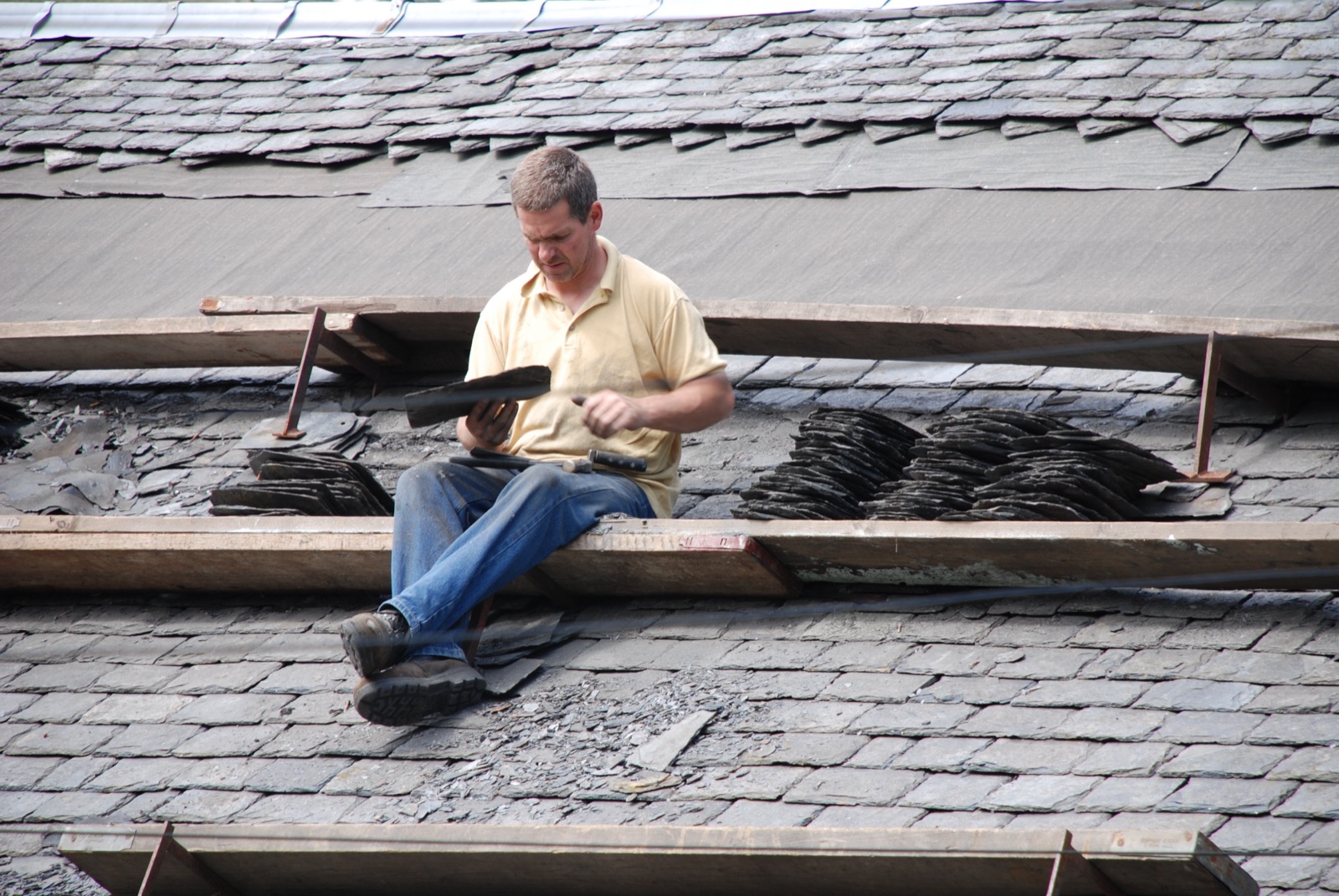
It helps to know what correct work is, because you can't see most of it from the ground. According to the Park Service, the installation and repair of slate roofs should be entrusted only to experienced slaters. A standard single-slate repair goes like this:
- The slater cuts or pulls out the nails holding the damaged slate, using a tool called a ripper slid under the slates. If the roof was laid with steel cut nails rather than copper, neighboring slates can be damaged in the process and may need repair too.
- A new or salvaged slate that matches the old one's size, shape, texture and weathered color is slid into place.
- It is held by one nail driven through the joint between the slates in the course above, and a strip of copper called a bib is slid up under the joint and bent over the nail head to keep water from entering the new nail hole. Metal hooks, clips and straps bent over the tail of the slate are alternative methods. The brief notes that tab-type copper straps are not recommended where snow and ice can fold the tab over and let the slate slide out, which is relevant in New Jersey winters.
- When several adjacent slates in a course are broken, or when valley flashings are being replaced, the slater removes slates in a pyramid pattern, so only the top slate in each pyramid needs a bib and the rest are held by nails.
If a lot of slates come off, the sheathing should be checked for rot and projecting nails. The brief advises against plywood as a replacement because a nail is hard to drive into it and the bounce can loosen neighboring slates, and against pressure-treated lumber because it shrinks. Replacement boards should match the old ones in width and thickness.
What shouldn't happen: the brief says roofing mastic or sealant is not a viable repair for damaged slates. It works at first, then hardens and cracks, makes later repairs harder, and accelerates corrosion on metal flashings. If a proposal for a leaking slate roof is “caulk it,” get a second opinion. Likewise, the brief says that when a roof must be replaced, the old slate should be removed to avoid overloading the roof timbers and that rotted sheathing should be replaced as the work goes.
One more detail worth knowing: the brief says artificial or mineral-fiber slate isn't recommended for restoration work, and that because labor, flashings and tear-off cost the same either way, the total up-front cost of an artificial slate roof is only marginally lower than natural slate. Ask any contractor proposing a substitute to explain what it would save in your specific case.
Hiring Someone Who Knows Slate
Plenty of excellent roofers install asphalt shingles every day and have never repaired a slate roof. Slate is a different trade, and the damage from an inexperienced crew can exceed the original problem. Start with the basics we cover in how to choose a roofer in Montclair: confirm New Jersey home improvement contractor registration, ask for the certificate of insurance, and get a written scope. Then add slate-specific questions:
- How many slate roofs on houses of this age have you repaired, and can I see or call about one nearby?
- What fasteners and flashing metal will you use? (Copper or stainless nails and 16-ounce or heavier copper are what the Park Service recommends.)
- How will you match the existing slate's size, color and thickness, and where will the matching slate come from? Can salvaged slate from the roof be re-used?
- How will you get on the roof without cracking slates? (Ladders hooked over the ridge or a lift are the methods the Park Service describes; “we just walk it” is not a good answer.)
- Do you plan to use any sealant or roofing cement? (The answer should be no.)
- What will you check besides the slates? Flashings, gutters, valleys, chimney junctions and the attic should all be on the list.
- What happens if rotted sheathing is found? Ask how that would be priced and approved before it's done.
Get at least two written estimates and line them up item by item. If one bidder is proposing a full tear-off and another a targeted repair, ask each to explain the 20 percent count behind their recommendation.
Permits and Historic Review in Montclair
Two separate questions come up on a slate roof in Montclair, and they shouldn't be confused.
Building permits. Whether a particular roofing job needs a permit depends on its scope under New Jersey's Uniform Construction Code and Montclair's Building Office practice. Our roofer-hiring guide goes through the state rule for re-roofing permits; start there, and then confirm with the Building Office for your address. Don't let a contractor tell you only that “no permit is needed” without saying why.
Historic Preservation Commission review. If your property is a local historic landmark or sits inside a local historic district, most visible exterior changes need a Certificate of Appropriateness before work starts. In-kind repairs that exactly match what is already there are typically treated differently from changes, but a roof's material and pattern are part of how a historic house looks from the street. The Park Service's own position is that significant slate roofs should not be stripped off and replaced with asphalt shingles, which is the same logic a preservation board applies. Read our guide to the certificate of appropriateness process before you accept a bid that swaps materials, and ask the Township how a repair using salvaged or matching slate would be classified.
If the house is also being sold or inherited, a documented roof history is a selling point: see our guide to selling an older Montclair home.
After a Storm: Stabilize First
When wind or a fallen limb knocks a number of slates off, the first job is keeping water out. The brief recommends installing a temporary covering immediately after a storm to prevent interior water damage and let the drying out begin. Heavy-gauge plastic or vinyl tarps are common but are hard to secure and can blow off in high wind; roll roofing carefully stitched into the remaining roof is a more functional temporary fix that buys time to document the existing roof, plan the repair and order matching material.
While the roof is stabilized, photograph everything, keep the broken slates (they may be useful for matching), and contact your homeowner's insurer to find out what its claim process requires. For water that has already come in, see our roof leak repair guide and, for interior damage, the water damage restoration guide. If the roof is at the replacement stage, our roof replacement guide covers the broader decision.
One timeline fact from the brief is useful for planning: on a roof with clear expanses, an experienced slater and one helper can cover about two to three squares a day, but chimneys, dormers and valleys can pull that below one square a day, and the brief suggests one square per day as a good average for planning, including flashings, gutters and scaffolding. A full slate replacement is measured in weeks, not days, and tear-off adds time.
Frequently Asked Questions
How long does a slate roof last?
The National Park Service's Preservation Brief 29 says properly installed slate roofs generally last 60 to 125 years or longer, depending on the type of slate, the roof's configuration and the climate. It gives Vermont and New York slate about 125 years, Buckingham Virginia slate 175 years or more, and Pennsylvania soft-vein slate more than 60 years. The fasteners and flashings usually give out well before the slate itself.
Is a leaking slate roof always a sign it needs to be replaced?
No. The National Park Service guideline says not to assume the slates are leaking: gutters, valleys and flashings are more likely sources, and condensation in a poorly ventilated attic can produce a 'false leak.' If fewer than about 20 percent of the slates are broken, cracked, missing or sliding and the roof is otherwise sound, the roof should be evaluated for repair rather than replacement.
Can I walk on my slate roof to check it?
You shouldn't. The Park Service says slate roofs should not be walked on if at all possible, because a person's weight cracks slates. Inspect from the ground with binoculars, from a lift, or from a ladder hooked over the ridge. If someone has to step on the slates, soft-soled shoes and stepping on the lower-middle of the exposed part of each slate spreads the load.
Should a roofer seal a cracked slate with roofing cement?
No. The National Park Service says mastic or sealants on damaged slates are not a viable repair, because they harden and crack and let water in later, make future repairs harder, and can accelerate corrosion of metal flashings. A cracked slate should be removed and replaced with a matching slate held by a nail and a copper bib, or by a metal hook or strap.
Do I need a permit or historic approval to repair a slate roof in Montclair?
It depends on the scope and on whether the house is a local landmark or inside a local historic district. Repairs that match what is already there are generally treated differently from changing the roofing material, and the Historic Preservation Commission reviews visible exterior changes on designated properties. Confirm with the Montclair Building Office and the Department of Planning & Community Development before work starts, and see our historic district and roofer-hiring guides below.
What does it cost to repair a slate roof in Montclair?
We don't publish a price here because slate repair is quoted job by job: it depends on the pitch, how many slates and flashings are involved, access and the cost of matching slate. Get at least two written estimates from contractors with slate experience, and compare the scope line by line, not just the total.
Related Montclair Guides
Sources: National Park Service, Technical Preservation Services, Preservation Brief 29, “The Repair, Replacement, and Maintenance of Historic Slate Roofs,” Jeffrey S. Levine (nps.gov); Montclair Township Historic Preservation Commission guidance as summarized in our certificate of appropriateness guide. This page is general information, not a roof inspection; slate condition has to be judged on the roof by an experienced slater.
Request a Slate-Experienced Roofer in Montclair
Describe the roof (age, what you've seen, whether the house is in a historic district) and we'll pass your request to local roofing contractors.