TLDR
Most older Montclair houses can get insulation into their exterior walls without tearing them open: an installer drills one or two holes per stud cavity and blows in dense-packed cellulose or fiberglass, then patches. Before that, three things can stop or reshape the job: live knob-and-tube wiring in the walls (the electrical code doesn't allow insulation around it), balloon framing that needs blocking first, and lead paint in a pre-1978 house. The federal 25C tax credit ended for work installed after December 31, 2025, so for 2026 projects the money side runs through PSE&G's programs: Whole Home Energy Solutions for most owners, and Comfort Partners or Home Weatherization for income-eligible households.
Insulating the Walls of an Older Montclair Home: Dense-Pack, Knob-and-Tube, Lead Paint and PSE&G Programs
Walk through almost any pre-war house in Montclair in January and you can feel it: the outside walls are cold to the touch, the radiators run hard, and the rooms on the windy side never quite warm up. Very often the reason is simple. The walls are hollow. Houses built before insulation was standard have plaster or drywall, studs, sheathing and siding, with nothing but air in between. This guide explains how wall insulation gets added to a house like that, what has to be checked first, and how to pay for it now that the federal credit is gone.
Are Your Walls Actually Empty?
Don't assume. Plenty of Montclair houses have had partial work over the decades: a room opened up during a kitchen remodel and insulated, an addition built to a newer code, or an older round of blown-in insulation that has since settled. The Department of Energy's Building America Solution Center, in its guide to blown insulation for existing exterior walls, lists three ways to check: a small cut-out in the interior wall, a look through the side of an outlet or switch box on an exterior wall (with the power off), or an infrared camera scan.
Infrared works best on a cold day, when the temperature difference between inside and outside is large. Empty bays show up as cold stripes between the studs; settled insulation shows up as a cold band at the top of each bay. An energy assessment usually includes this scan along with a blower-door test that measures how leaky the house is overall.
What you find decides the job. Empty cavities are the easy case. Old blown insulation that has settled can usually be topped up. Old fiberglass batts that have sagged are the awkward case: the DOE guide notes that deteriorated batts can block new blown insulation from filling the cavity, and suggests either cutting a strip of wall near the floor to pull them out or using infrared afterward to confirm the new material filled around them.
How Drill-and-Fill Works
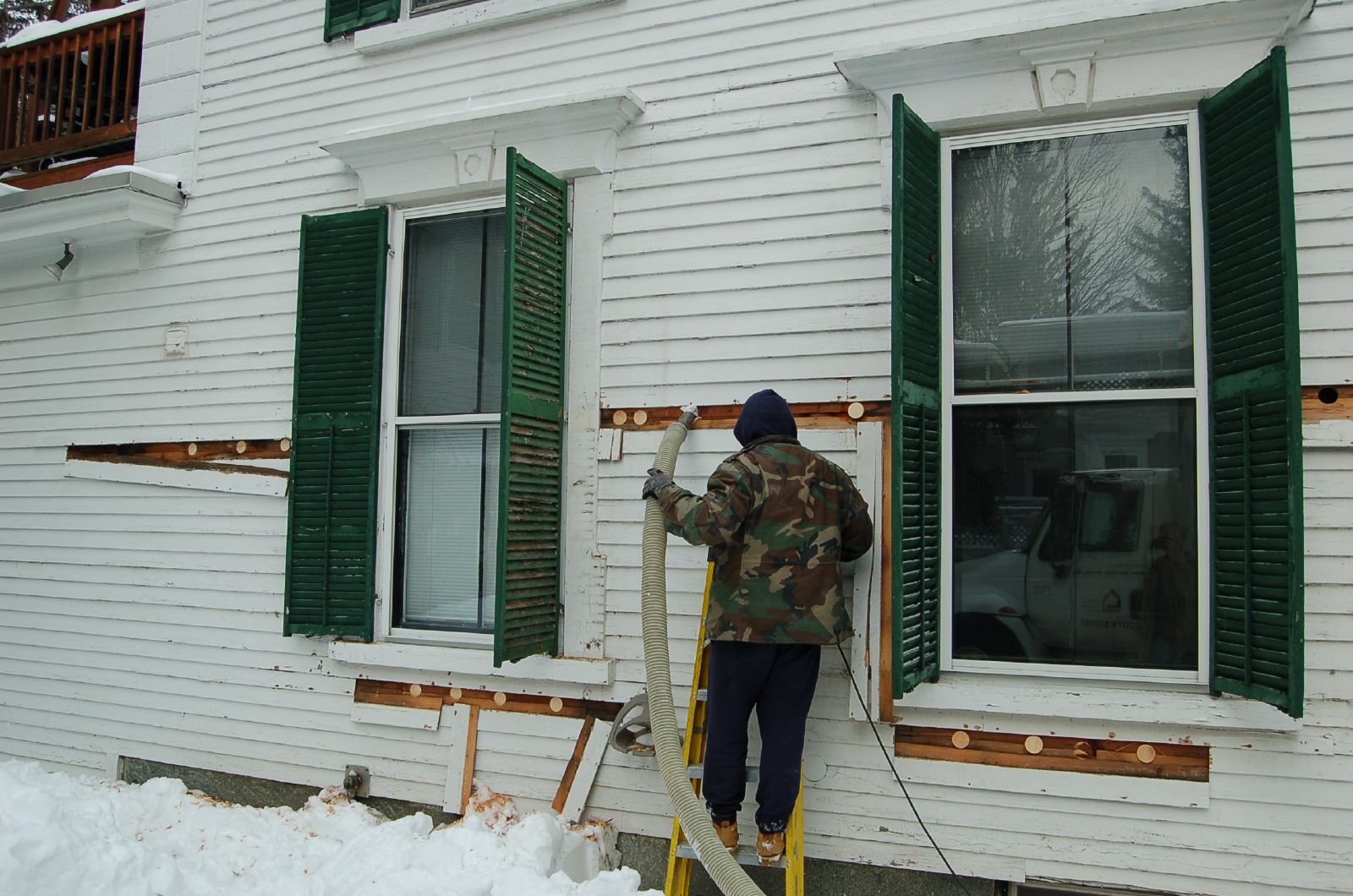
The standard retrofit method has a plain name: drill-and-fill. Based on the DOE guide, a careful job looks like this:
- Map the framing. The crew finds and marks the studs, and uses infrared to spot blocking, fire stops and cross-bracing that will interrupt the fill.
- Drill access holes. Typically a 1- or 2-inch hole near the top of each stud cavity, about six inches below the ceiling, sized to the blower nozzle. Extra holes go below any blocking, and in the short cavities above and below windows and over door headers, which are easy to miss.
- Blow to dense-pack density. Dense-pack means filling the cavity tightly enough that the material won't settle and also slows air movement through the wall. The density target comes from the insulation manufacturer, not from the installer's feel.
- Verify before patching. The DOE guide says to recheck every cavity with an infrared camera before closing the holes. Ask whether your contractor does this and whether you'll get the images.
- Patch and restore. Inside, holes are plugged and finished with joint compound and paint. Outside, the siding is patched or reinstalled, and any breach in the drainage plane (house wrap or building paper) has to be repaired so the wall still sheds water.
Cellulose and blown fiberglass are both used for dense-pack. Some contractors also offer injection foams for closed cavities. Whatever the material, the same questions apply: how will they verify full fill, and how will they restore the surface they drilled through?
From Inside or From Outside?
Both work. The choice in a Montclair house usually comes down to what you'd rather repair afterward.
| Approach | Works well when | Watch out for |
|---|---|---|
| From inside | Rooms are being painted anyway; siding is masonry, stucco or historic clapboard you don't want touched | Patching plaster cleanly; built-ins and cabinets on exterior walls; tile in bathrooms; dust and lead in pre-1978 rooms |
| From outside, through siding | Wood, vinyl or fiber-cement siding that can be lifted or drilled and plugged; occupied house | Visible plugs on painted clapboard; repairing the drainage plane; lead paint on old exterior trim |
| During re-siding | You're already replacing siding | The DOE guide calls this an ideal time: you can also air-seal sheathing and add rigid foam outside |
If re-siding is on the horizon, coordinate the two. Our siding replacement guide covers that side of the project, and the timing can save you paying twice to open and close the same wall.
The Four Things That Stop a Wall Job
1. Live knob-and-tube wiring
Many houses built in the early twentieth century were wired with knob-and-tube, and some of it is still in service inside walls. The DOE guide is direct about it: the National Electrical Code's knob-and-tube article doesn't allow insulation to be applied to or surround that wiring. Knob-and-tube was designed to shed heat into open air, which insulation prevents. So the first step on a pre-war house is an electrician's check of which wall circuits are live. Live knob-and-tube in a cavity you want to insulate needs to be replaced or abandoned first. Our knob-and-tube replacement guide explains that project, and it often makes sense to rewire and insulate in the same season, since the electrician's fishing holes and the insulator's fill holes can overlap.
2. Balloon framing
Older houses were often balloon framed: the studs run continuously from the sill to the roof, so each wall cavity is an open chute from the basement to the attic. Blow insulation into that and it can fall straight through. The DOE guide says that if walls are balloon framed, blocking has to be installed at the top and bottom of the cavities, separating them from the basement and attic, before dense-packing is possible. That blocking also matters for fire safety, because open balloon cavities let fire and smoke travel between floors. Ask any contractor bidding an older Montclair house how they will confirm the framing type and how they will block it.
3. Lead paint in a pre-1978 house
Drilling through painted plaster or old painted siding disturbs paint. For homes built before 1978, the EPA's Renovation, Repair and Painting (RRP) rule generally requires that paid work disturbing more than six square feet of painted surface inside, or more than twenty square feet outside, be done by an EPA-certified firm using lead-safe practices. A full house of drill-and-fill can easily pass those thresholds, especially if siding comes off. Our lead paint testing guide covers testing first, which tells you whether the precautions apply to the surfaces being drilled.
4. A historic facade
Montclair has several historic districts and individually designated landmarks, and exterior changes on those properties can require review by the Historic Preservation Commission. Insulation itself is invisible, but rows of plugged holes in historic clapboard, or siding removed and replaced, are not. If your house is in a district, read our guide to the certificate of appropriateness and check with the Township before the crew arrives. Drilling from inside often sidesteps the question entirely.
Two smaller issues are worth raising too. Moisture: a wall that leaks from outside (failed flashing, missing gutters, rotted sills) should be repaired before it's filled, because insulation slows drying. And permits: requirements depend on the scope, especially if electrical or siding work rides along, so confirm with the Montclair Building Department rather than assuming.
Paying for It in 2026
The federal credit is gone for new work. The Section 25C Energy Efficient Home Improvement Credit covered insulation and air sealing through 2025. Public Law 119-21, the law widely called the One Big Beautiful Bill Act, ended it for property placed in service after December 31, 2025. The IRS says the credit is claimed for the year the work is installed, not merely purchased, so a 2026 wall job doesn't qualify even if it was paid for last year. Be wary of any contractor still quoting it.
PSE&G Whole Home Energy Solutions. Montclair is in PSE&G territory. According to PSE&G, the program is for current residential customers who own the one- to four-family home being assessed. A Building Performance Institute (BPI) certified contractor tests the house (insulation levels in walls, ceilings and attic, air leakage, heating and hot water systems, and combustion safety) and recommends upgrades. PSE&G says homeowners may receive rebates and may qualify for interest-free on-bill repayment, and you must use a participating contractor to get them. The contractor sets the price of the assessment.
Income-eligible programs. PSE&G's Comfort Partners page, part of New Jersey's Clean Energy Program, lists insulation upgrades and air sealing among no-cost measures for qualifying customers, with 2026 guidelines set at 250% of the federal poverty guidelines (for example, $82,500 a year for a family of four). Its Home Weatherization program covers households between 250% and 400% of the poverty level and lists wall, ceiling and attic insulation among possible no-cost upgrades, with exclusions such as homes listed for sale.
Program rules, funding and contractor lists change, so confirm the details with PSE&G and get the rebate amount in writing before work starts. Our home energy audit guide explains what the assessment visit involves.
Hiring a Contractor: What to Ask
Wall insulation is a job where the quality is hidden the moment it's finished, so the questions you ask up front matter more than usual. Get at least two written proposals and compare them on these points, not just the total:
- Pre-work checks: Will they test for live knob-and-tube or require an electrician's sign-off? How will they confirm balloon framing and block it?
- Material and density: Which product, and what manufacturer density will they blow to?
- Verification: Will they scan with infrared after filling and before patching, and share the images?
- Holes and patching: Inside or outside? How many holes per cavity? Who patches, primes and paints, and to what finish?
- Lead-safe work: Is the firm EPA RRP certified, and how will they contain dust in a pre-1978 house?
- Program participation: If you're using the PSE&G program, are they a participating Whole Home Energy Solutions contractor with BPI certification?
- Registration and insurance: New Jersey requires home improvement contractors to register with the Division of Consumer Affairs; ask for the registration number and a certificate of insurance. Our guide to choosing a contractor in Montclair covers the contract terms to look for.
If the attic is still uninsulated or leaky, it's usually the cheaper first step. Our attic insulation guide covers that job, and a good contractor will tell you honestly which part of your house to do first.
Frequently Asked Questions
Can you add insulation to existing walls without removing the plaster?
Usually, yes. The common method is drill-and-fill: the installer drills a hole near the top of each stud cavity, from inside or from outside, and blows in cellulose or fiberglass to a dense-pack density, then patches the holes. The U.S. Department of Energy's Building America Solution Center describes it as a common and somewhat uninvasive method for existing walls. Cavities with blocking, fire stops or old batts may need extra holes.
Can wall insulation be blown in around knob-and-tube wiring?
Not around wiring that is still live. The DOE Building America guide notes that the National Electrical Code (Article 394) does not allow insulation to be applied to or surround knob-and-tube wiring. A licensed electrician has to confirm whether old circuits in the wall are live, and live knob-and-tube in those cavities needs to be replaced or abandoned before they are insulated.
Is there still a federal tax credit for insulation in 2026?
No. The One Big Beautiful Bill Act ended the Section 25C Energy Efficient Home Improvement Credit for property placed in service after December 31, 2025. The IRS says the credit is claimed for the year the work is installed, not paid for, so insulation installed in 2026 does not qualify.
Does PSE&G help pay for wall insulation in Montclair?
PSE&G's Whole Home Energy Solutions program is open to residential customers who own one- to four-family homes and works through BPI-certified participating contractors; PSE&G says projects may qualify for rebates and interest-free on-bill repayment. Income-eligible customers may qualify for free insulation and air sealing through Comfort Partners or PSE&G's Home Weatherization program. Check eligibility and current terms with PSE&G before signing a contract.
Do I need to worry about lead paint when insulating walls?
If the house was built before 1978 and the work disturbs painted surfaces, the EPA's Renovation, Repair and Painting rule generally requires a lead-safe certified firm once the work disturbs more than six square feet of paint inside or twenty square feet outside. Drilling and patching plaster or removing siding can cross those lines, so ask the contractor for their RRP firm certification.
Should walls or the attic come first?
In most older homes the attic and basement rim are cheaper places to start, because they are easier to reach and air leakage there is often large. Walls are worth doing when they are empty or nearly empty, which a contractor can check with an infrared camera or a small inspection hole. An energy assessment that includes a blower-door test is the best way to rank the work for your house.
Related Montclair Guides
Sources: U.S. Department of Energy, Building America Solution Center, “Blown Insulation for Cavities of Existing Exterior Walls” (basc.pnnl.gov); IRS, “Energy Efficient Home Improvement Credit” and OBBB FAQs on sections 25C and 25D (irs.gov); PSE&G, Whole Home Energy Solutions, Home Weatherization and Comfort Partners pages (pseg.com); EPA Renovation, Repair and Painting rule (40 CFR Part 745). Checked November 2, 2026. This guide is general information, not engineering, electrical or tax advice; program terms change, so confirm with PSE&G and your contractor.
Get Wall Insulation Quotes in Montclair
Tell us about the house (age, siding, whether you know of knob-and-tube) and we'll pass your request to local insulation contractors.