Updated November 12, 2026
Wood Window Restoration in Montclair, NJ: Repair or Replace, and What the Job Involves
Montclair has a lot of old wood windows: double-hung sash in Victorians and Colonial Revivals, casements in Tudors, divided lites that were made one piece at a time. When they rattle, stick or let the November wind in, the first quote is often for replacement. This guide is about the other option: what restoring them involves, how to tell whether yours can be saved, and the lead, permit and historic-district rules that apply in town.
Short answer
Most old wood windows that seem broken have a handful of fixable problems: failed glazing putty, broken sash cords, paint build-up and missing weatherstripping. The National Park Service says most historic wooden windows can be repaired, and that caulking, weatherstripping and reglazing should come before any replacement decision. Pair a restored sash with a low-e storm window and DOE says heating and cooling costs can drop 10% to 35%. In a pre-1978 house, hire an EPA Lead-Safe Certified firm. In a historic district, repairs and matching storms don't need Commission review; changing the window does.
Start with an inspection, window by window
The NPS's Preservation Brief 9 is still the reference most restorers work from. Its advice is to look at each window as its own case, because a house rarely has twenty identical problems. The south and west sides weather faster; the window over a leaking gutter is in worse shape than the one beside it.
Peeling paint is not proof of rot. The brief says wood is frequently sound under ugly paint, and that paint failure is better read as a map of where water gets in. Water runs down the window and stops where something blocks it: the sill, the joint between sill and jamb, the bottom corners of the sash and the muntin joints. Those are the places to check.
The test it describes needs nothing more than an ice pick or an awl. Wet the wood, push the point in at an angle and pry up a small piece. Sound wood lifts in long, fibrous splinters. Decayed wood breaks off in short, irregular pieces. For a sill you can't see under, push straight in: a rotten core will let the probe through a surface that looks fine. Photograph each window and keep a simple list. That list is what a restorer will price from, and it is the same documentation Montclair's Commission asks for if you ever apply to replace a window.
What restoration actually involves
Preservation Brief 9 groups window work into three classes, and they map neatly onto how a restoration bid should read. Class I is routine maintenance: paint removal, freeing and reglazing the sash, repairing the frame, weatherstripping and repainting. Class II is stabilizing wood that is partly decayed, by consolidating or patching it. Class III is replacing parts that can't be stabilized, with splices or new pieces made to match. Each class takes more time and skill than the one before. Here is how that plays out on a typical Montclair double-hung:
| Part | What you notice | Usual fix |
|---|---|---|
| Glazing putty | Cracked, missing or falling out; glass rattles | Remove failed putty, re-set the glass with glazier points, new glazing compound, prime and paint. Routine (NPS Repair Class I). |
| Sash cords and weights | Window won't stay up, or slams down | Open the weight pocket, replace broken cords, rebalance. Routine, and one of the most common reasons an old window seems broken. |
| Paint | Painted shut, peeling, bare wood showing | Free the sash, remove failed paint where needed, prime and repaint. Lead-safe work practices if the house is pre-1978. |
| Weatherstripping | Drafts at the meeting rail and sides | Add or replace weatherstripping at jambs, meeting rails and the bottom rail. The NPS lists this with caulking and reglazing as the first step before any replacement talk. |
| Bottom rail and joints | Soft wood, open corner joints | Consolidate or patch partially decayed wood (Class II), or re-glue and pin loose joints. |
| Sill | Rot at the sill or sill-to-jamb joint | Epoxy repair for limited decay, or a spliced-in section or new sill made to match (Class III). Fix the water source first. |
The brief's rule of thumb is useful when you're weighing bids. The NPS weatherization guidance puts it plainly: if most of the work falls into the first two classes, the windows should be repaired; if a large number of new parts are required, a good matching replacement may be the better investment. A restorer who quotes Class III work on every window without showing you the decay is a restorer to question.
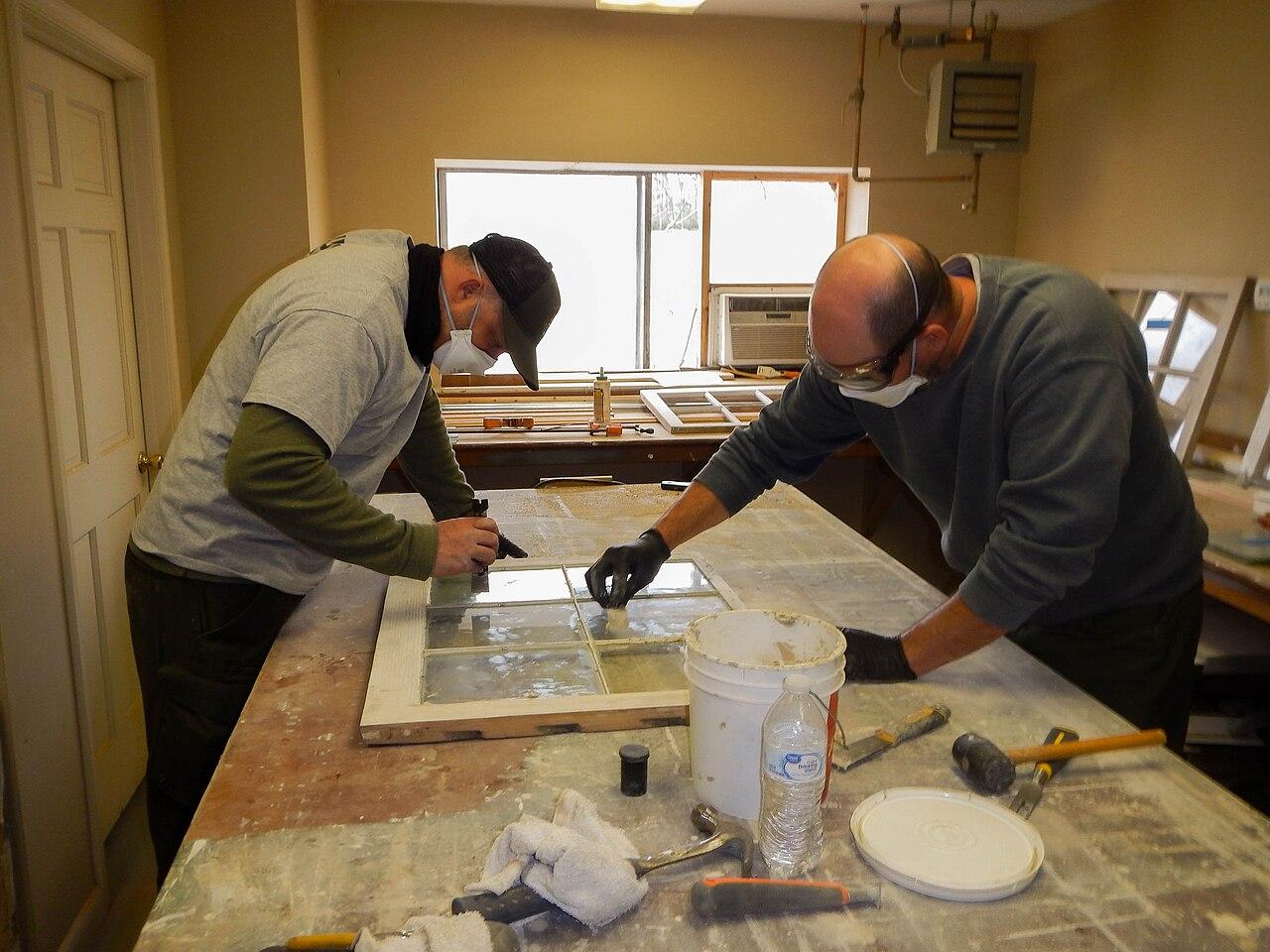
Sash are often taken to a shop for stripping and reglazing, which means the openings get covered while they are out. Ask how long each window will be open or boarded, and plan the job for a mild stretch of the year.
Want a restoration quote for your windows?
Tell us how many windows, what style, and what's wrong with them. We pass requests to local window and carpentry pros. Routing a request is not an endorsement of any company.
Restore plus storm windows vs. replacement
The energy argument for replacement is weaker than most sales pitches suggest. The National Park Service's weatherization guidance calls the idea that new windows save as much as 50% on energy costs a misconception, says a replacement window does not generally pay for itself in a reasonable time, and points out that new window units can't be repaired, only replaced again.
Heat leaves through the glass and through the gaps around the sash. Weatherstripping and fresh glazing deal with the gaps. A storm window deals with the glass. The Department of Energy reports that a low-e storm window installed over a low-performing window can reduce a home's heating and cooling costs by 10% to 35%, based on testing led by Pacific Northwest National Laboratory. Interior storms are an option where exterior ones would change how the house looks.
Replacement can still be the right call: frames rotted through, sash missing, a later window that was never original, or an addition you're rebuilding anyway. If you're leaning that way, our window replacement guide for Montclair covers what drives those quotes.
Lead paint: the rule that shapes every bid
Windows are where lead paint does the most harm, because sliding sash grind painted surfaces into dust. If your house was built before 1978, EPA's Renovation, Repair and Painting rule applies to paid work that disturbs painted surfaces. Small jobs fall under a minor-repair exception (6 square feet or less per room inside, 20 square feet or less outside), but that exception never applies to window replacement, and stripping a set of sash will often exceed it.
For covered work, the company must be an EPA Lead-Safe Certified Firm with a certified renovator, set up containment, and clean and verify the work area afterward. Put the certification number in the contract. A restorer who plans to dry-scrape or heat-gun sash in your living room without containment is not following the rule. Our lead paint testing and abatement guide covers testing first if you aren't sure what's on your trim.
Permits and Montclair's historic districts
Repairing existing windows is ordinary maintenance under the New Jersey Uniform Construction Code. N.J.A.C. 5:23-2.7 also lists replacing a window or door in the same opening, storm windows included, without changing the opening's size or framing as ordinary maintenance. Enlarging an opening, adding a window or changing framing takes you out of that category and into a permit.
Historic review is a separate question. If your house is in one of Montclair's historic districts or is an individual landmark, the township's ordinance exempts repairs that don't change design, scale or appearance, and storm windows that don't change design, scale or appearance. Replacing wood windows with a different material or muntin pattern on a visible elevation is a change in exterior appearance and needs a certificate of appropriateness. Our guide to Montclair historic district rules covers what that application asks for. Restoration is the path of least resistance there.
Hiring a window restorer
- Check New Jersey home improvement contractor registration with the Division of Consumer Affairs, and ask for proof of liability insurance.
- Ask for the EPA Lead-Safe Certified Firm number if the house is pre-1978.
- Get a window-by-window scope that separates routine work (reglazing, cords, weatherstripping, paint) from wood repair and part replacement.
- Ask what glazing compound, primer and paint they use, and how long glazing must cure before painting.
- Ask whether sash are worked on in place or in a shop, and how openings are protected while sash are out.
- Ask for photos of recent restoration work on houses of a similar age, and the option to see a finished window.
Restoration is a specialty. A general handyman may handle cords and weatherstripping well, but stripping, reglazing and wood repair on old sash is slower, fussier work. For the bigger picture on keeping an older house sound, see our older-home maintenance guide.
FAQ
Is it worth restoring old wood windows in Montclair?
Often, yes, if the sash and frames are mostly sound. The National Park Service's Preservation Brief 9 says most historic wooden windows can be repaired, and its weatherization guidance says caulking, weatherstripping and reglazing should come before any decision to replace. Replacement makes more sense when a large share of the parts would have to be remade, or when the frames themselves are badly decayed.
Do new windows save more energy than restored windows with storms?
Not necessarily. The NPS calls the idea that replacement windows save as much as 50% on energy costs a misconception and says a replacement window does not generally pay for itself in a reasonable time. DOE reports that a low-e storm window installed over a low-performing window can cut a home's heating and cooling costs by 10% to 35%. A tight, weatherstripped sash with a good storm window is a reasonable alternative to replacement.
Do I need a lead-safe certified contractor to restore my windows?
If the house was built before 1978 and the work disturbs painted surfaces above EPA's minor repair limits (more than 6 square feet per room inside or 20 square feet outside), the contractor must be an EPA Lead-Safe Certified Firm using a certified renovator. Window replacement is always covered, regardless of size. Ask for the firm's certification in writing.
Do I need a permit to restore windows in Montclair?
Repairs to existing windows are generally ordinary maintenance under the NJ Uniform Construction Code, and N.J.A.C. 5:23-2.7 lists replacing a window in the same opening, including storm windows, without changing its size or framing as ordinary maintenance too. Enlarging or moving an opening is different. Separately, if your house is in a Montclair historic district or is a landmark, a change in material, muntin pattern or appearance on a visible elevation needs Historic Preservation Commission review.
Can I keep my original windows in a Montclair historic district?
Yes, and the review process favors it. Montclair's ordinance exempts repairs that don't change design, scale or appearance, and storm windows that don't change design, scale or appearance. Replacing original windows with a different material or pattern is a change in exterior appearance and goes through the Commission with photos, cross-sections and a conditions statement.
How do I tell if a window sash is rotten?
Preservation Brief 9 describes a simple probe test: push an ice pick or awl into wetted wood at an angle and pry up a little. Sound wood lifts in long fibrous splinters; decayed wood breaks off in short irregular pieces. Check the sill, the sill-to-jamb joints, the bottom rail corners and the muntin joints, where water collects.
Request a Montclair window restorer
Sticking sash, broken cords, failing putty or rot at the sill. Tell us the job and we'll route it to local pros. Routing a request is not an endorsement of any company.
Sources accessed November 12, 2026: NPS Preservation Brief 9, The Repair of Historic Wooden Windows; NPS, Weatherization of Historic Buildings: Windows and Doors; U.S. DOE, low-e storm windows success story; EPA, RRP Program for Contractors; N.J.A.C. 5:23-2.7 (ordinary maintenance). This guide is general information; your building office, the Historic Preservation Commission and your contractor's written scope control the details. Photo: NPS / Wikimedia Commons, public domain.